Watch the guide video
Quick answer
The best turntable with built-in speakers for most buyers is not simply the loudest or most feature-packed one. Look for stable speed, a decent tonearm and cartridge, replaceable stylus, sensible speaker placement, and outputs that let you add better speakers later.
Choose an all-in-one if simplicity matters more than hi-fi performance. If sound quality is your main priority, a separate turntable and powered speakers will usually be the better long-term choice.
Key Takeaways
A built-in speaker record player is best for convenience, small rooms and casual listening. It is not the ideal choice if you want deep bass, wide stereo imaging or the easiest upgrade path.
The most important buying checks are mechanical rather than flashy. A record player still has to spin accurately, hold the stylus steadily in the groove, and avoid sending speaker vibration back into the turntable.
Prioritise these essentials:
- Replaceable stylus, so you are not stuck when the needle wears out
- Adjustable or well-designed tonearm, so records are treated properly
- Line output or headphone output, so you can connect external speakers later
- Reliable speed control for 33 and 45 rpm records
- A solid plinth or cabinet that does not rattle easily
Treat extras such as Bluetooth, USB recording, radio, CD playback and retro styling as conveniences. They can be useful, but they should not compensate for weak record-playing fundamentals.
Who This Guide Is For
This guide is for buyers who want a simple record player that works without a separate amplifier or hi-fi speakers. That includes first-time vinyl listeners, students, gift buyers, occasional collectors and anyone who values a tidy setup.
It is also useful if you are comparing compact all-in-one players with bundled-speaker systems. For example, a suitcase-style player, a retro music centre and a turntable sold with separate powered speakers all solve the same problem in different ways.
This guide is not aimed at buyers building a serious hi-fi system from the start. If you already own good speakers or plan to upgrade quickly, you may be better served by a conventional turntable with a built-in phono stage or a separate phono preamp.
What to Consider Before Buying
Start with the room and listening distance. Built-in speakers are usually small, so they work best when you are fairly close to the player and not trying to fill a large lounge.
Think about how often you will use it. For the odd record on a Sunday morning, convenience may matter more than absolute sound quality; for daily album listening, comfort, reliability and upgrade options become more important.
Check what records you own or plan to buy. Most LPs need 33 rpm, most singles need 45 rpm, and some older shellac records need 78 rpm with a suitable stylus.
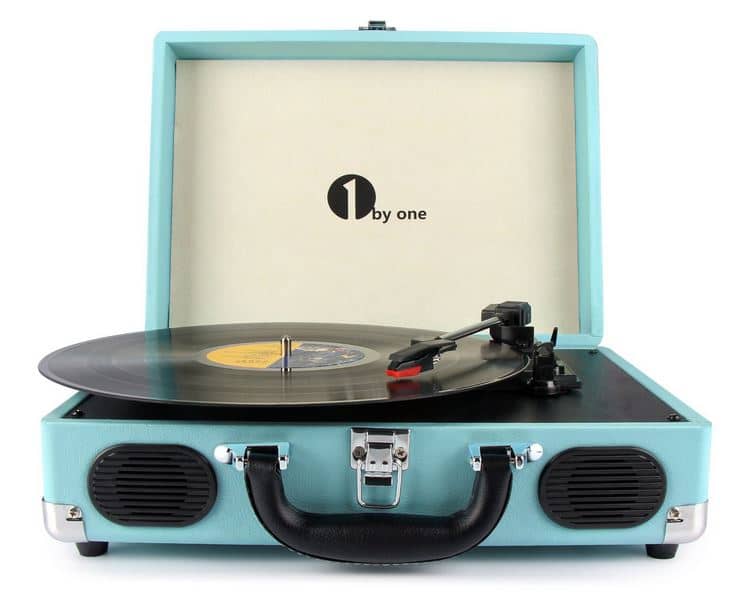
Decide whether the player must be portable. Briefcase and suitcase designs are easy to move, but the compact build often limits speaker size, isolation and tonearm quality.
Consider where it will sit. A wobbly shelf, resonant sideboard or surface shared with heavy footfall can cause skipping, buzzing or muddy sound.
Features That Matter Most
Speed stability is one of the first things to check. If the platter runs slightly fast, slow or unevenly, piano notes and vocals can sound unsteady, even if the speakers are acceptable.
The tonearm matters because it controls how the stylus sits in the groove. A very basic arm with no counterweight or anti-skate adjustment can be less kind to records than a better-designed arm with correct tracking force.
A replaceable stylus is essential. Needles wear with use, and a worn stylus can sound rough and may increase record wear.
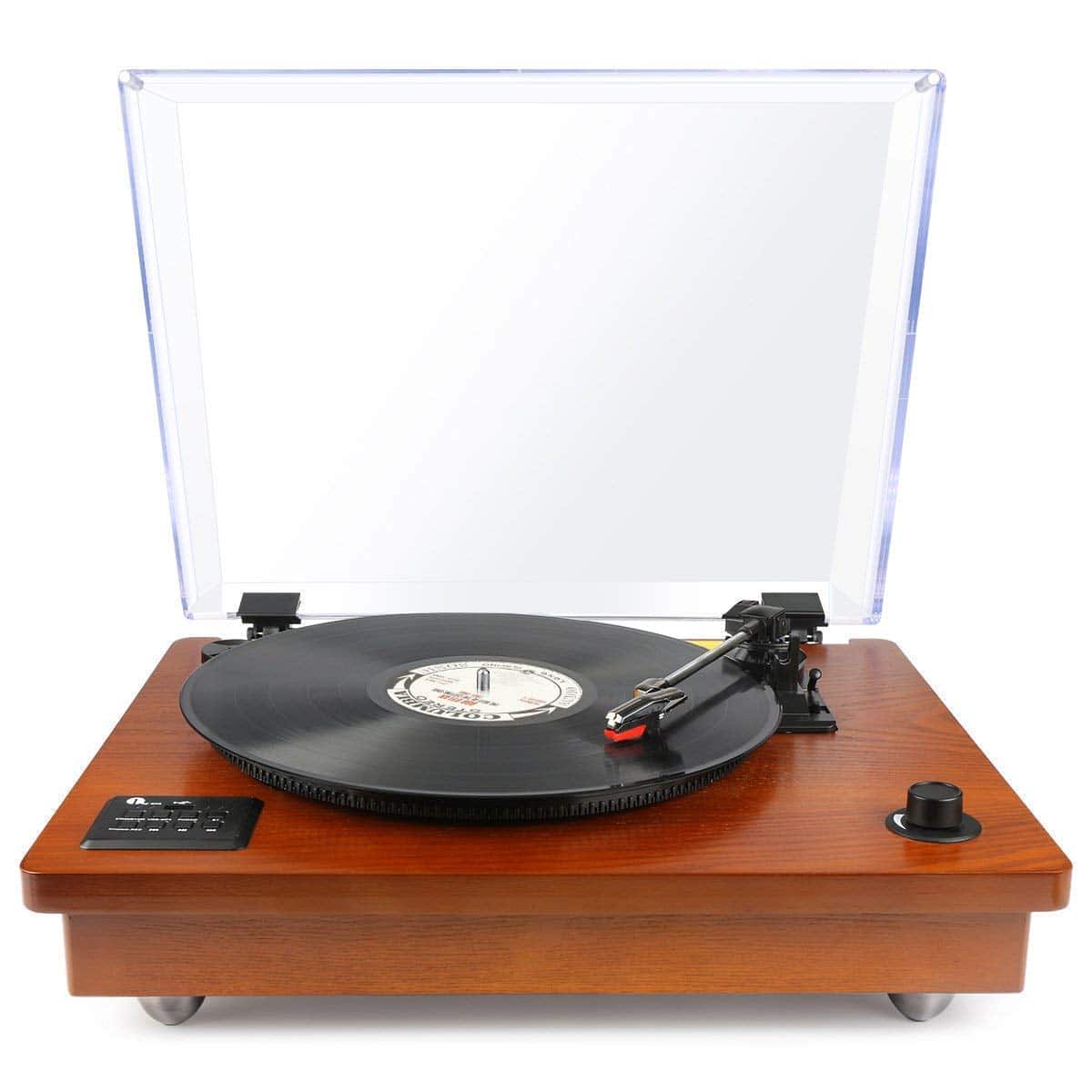
The cartridge is the small part at the end of the tonearm that holds the stylus and turns groove movement into an electrical signal. Some all-in-one players use basic ceramic cartridges; others use moving magnet cartridges, which are more common in hi-fi turntables and easier to match with external equipment.
Speaker design is just as important as speaker quantity. Two tiny speakers in the same cabinet will not create much stereo width, while a system with separate speakers, such as some record-player-with-speakers packages, can place left and right channels further apart.
Look for useful outputs. A line output, RCA output or headphone socket can let you connect powered speakers, a hi-fi amplifier or headphones, depending on the model.
Bluetooth can mean different things. Bluetooth input lets you play music from your phone through the record player’s speakers, while Bluetooth output lets the turntable send record playback to wireless speakers or headphones.
USB recording is optional. It can be handy for digitising records, but it should not be the deciding feature unless you genuinely plan to make digital copies.
Built-in Speakers Versus Separate Speakers
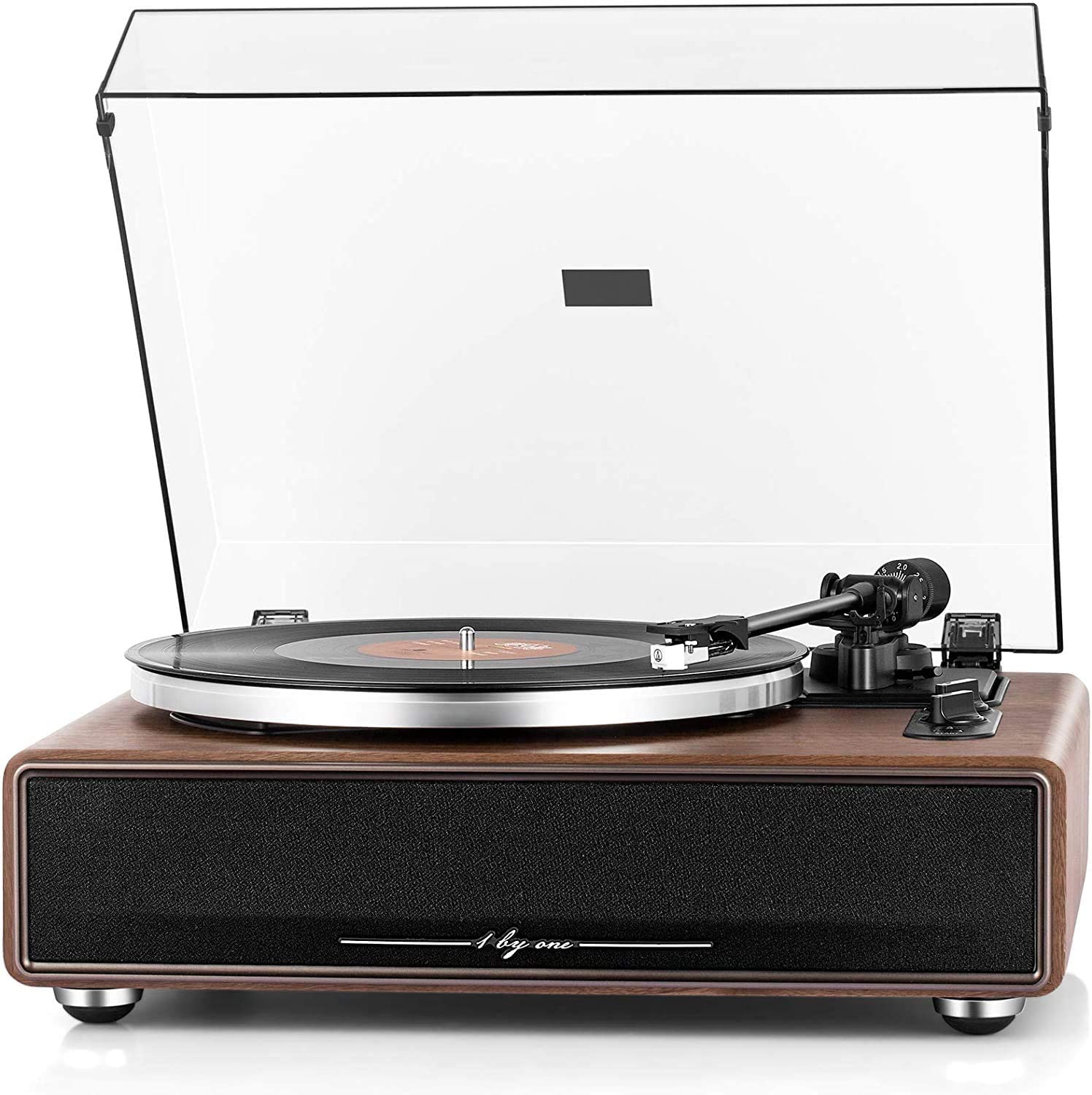
A true built-in speaker player has the speakers inside the same cabinet as the turntable. This is neat and convenient, but it places vibrating speakers close to the stylus and platter.
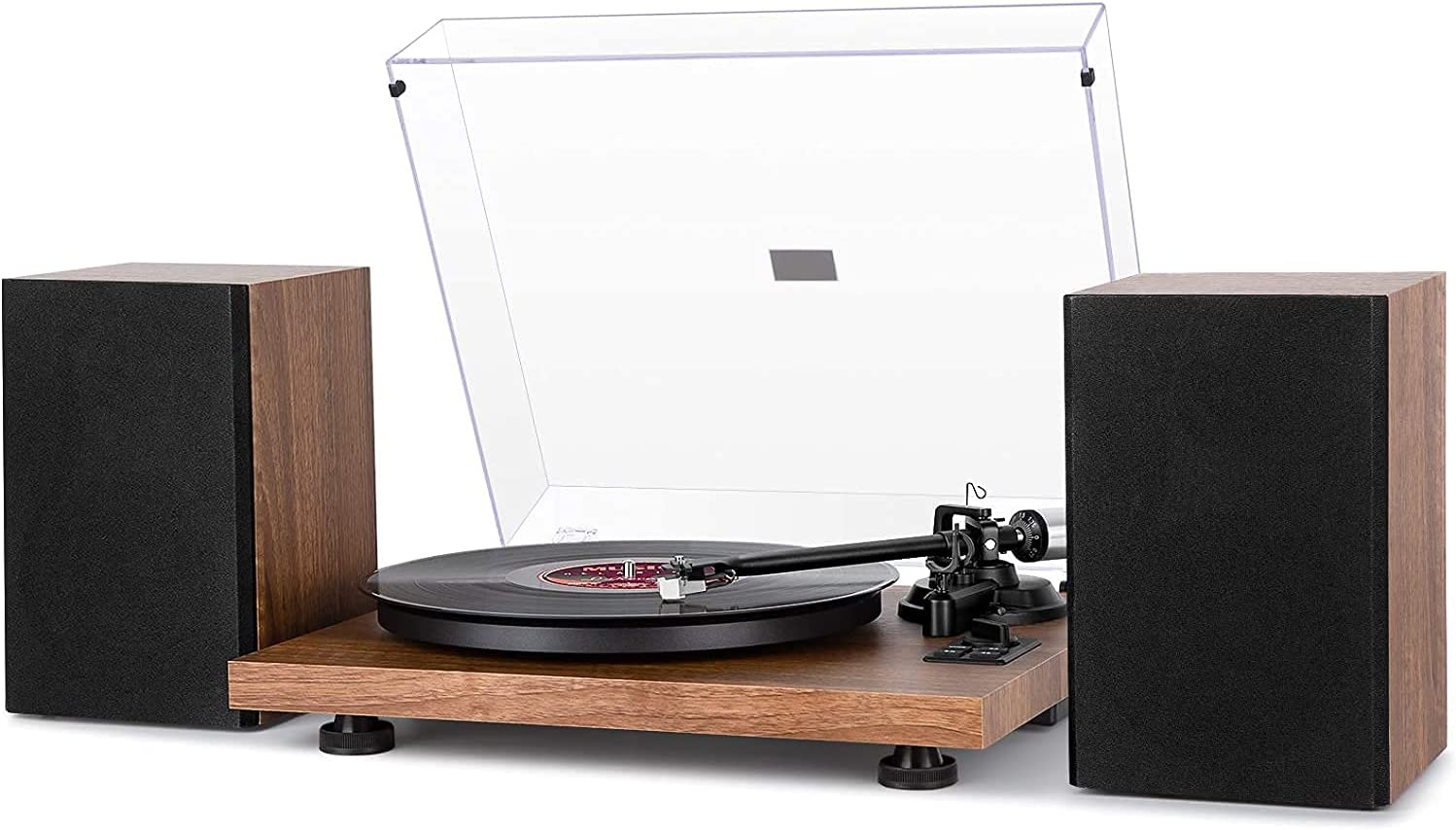
A bundled-speaker system includes a turntable and separate speakers in the box. Models such as the Crosley C62 Bluetooth Record Player With Speakers and Lenco LS-300 Bluetooth Record Player are examples of this type in broad terms, though you should still check the exact specification before buying.
Separate speakers usually give you better stereo separation because you can place them apart. They can also reduce vibration reaching the record player, especially if the speakers sit on different furniture or isolation pads.
Built-in speakers make most sense when you want one compact unit. Separate speakers make more sense when you have enough space and care more about sound quality.
There is a third option: a standard turntable plus powered speakers. For example, powered bookshelf speakers such as Edifier R1280DB, House of Marley Get Together Duo, Sanyun SW206 or Wharfedale Diamond 9.1-style speaker options may be relevant depending on whether amplification is built in or required separately.
Sound Quality and Record Care Trade-offs
All-in-one record players are designed around compromises. The cabinet must hold a platter, arm, amplifier and speakers, so there is limited space for larger speaker drivers, heavier construction and isolation.
Bass is usually the first limitation you will notice. Small built-in speakers can sound clear at low volume, but they rarely produce the weight or scale of a pair of decent bookshelf speakers.
Stereo image is another trade-off. If the left and right speakers are only a short distance apart, the sound can feel centred in the box rather than spread across the room.
Record care depends on stylus quality, tracking force and tonearm design. A player with a replaceable stylus and a tonearm that tracks correctly is a safer long-term bet than a very cheap unit with unknown parts.
Volume also affects performance. Pushing small speakers hard can cause cabinet vibration, distortion and skipping on some designs.
Connectivity and System Compatibility
Before buying, check what you want the player to connect to now and in future. The right socket can make the difference between a short-term gadget and a useful starter system.
Line output is one of the most useful connections. It sends a standard signal to powered speakers, an amplifier, a soundbar with analogue input, or another audio system that accepts line-level audio.
Phono output is different from line output. A phono signal is much quieter and needs a phono preamp before it will work properly with most speakers and amplifiers.
A built-in phono preamp means the turntable can output a stronger line-level signal. Some turntables have a switch marked phono/line, which is helpful if you later move between hi-fi systems.
Headphone sockets are convenient for private listening, but check whether plugging in headphones mutes the speakers. Also remember that headphone quality will still be limited by the player’s internal electronics.
Bluetooth output can be useful, but it introduces compression and possible delay. It is fine for casual listening, but wired speakers are normally more reliable for serious record playback.
Bluetooth input is mainly for convenience. It lets the unit act as a small speaker for your phone, but it does not improve vinyl playback.
If you already own active speakers, look for RCA or 3.5 mm line output. If you own passive speakers, you will usually need an amplifier between the record player and speakers unless the system includes one.
Budget and Value Considerations
Set your budget around how serious you are about records. The cheapest all-in-one players are tempting, but they often make the biggest compromises in tonearm quality, speaker performance and long-term serviceability.
At entry level, focus on the basics rather than a long feature list. A simple player with a replaceable stylus and usable output may be better value than a 10-in-1 cabinet with weak record playback.
Mid-range all-in-one and bundled-speaker systems can be a sensible compromise. They often offer better cabinets, more practical connectivity and speakers that are easier to live with.
If your budget stretches further, compare against a separate system. A turntable such as an Audio-Technica, Sony, Pro-Ject, Rega, Fluance, Teac or Denon model paired with powered speakers may provide better sound and upgrade flexibility, depending on the exact model and setup.
Do not spend extra for features you will not use. Radio, cassette, CD, USB recording, app control and decorative lighting may be enjoyable, but they are not essential for playing records well.
Choosing for Different Buyers
For a first-time listener, choose simplicity with safeguards. Look for easy speed selection, a cueing lever, replaceable stylus and line output.
For a teenager or student room, compact size and Bluetooth may matter more. Still check that the lid clears properly, the unit sits level, and the tonearm is not too flimsy.
For a gift, avoid anything that needs complicated setup unless the recipient wants to learn. A fully automatic or easy-start player can reduce the chance of damaged records or stylus mishaps.
For someone with a growing record collection, prioritise upgrade paths. Line outputs, a better cartridge system and separate speakers will keep the player useful for longer.
For a kitchen, bedroom or casual space, built-in speakers are acceptable if expectations are realistic. Choose something stable, easy to clean and not too bass-heavy for nearby furniture.
For listeners who care about sound quality, consider a bundled-speaker or separate turntable system instead of a true built-in speaker unit. Even modest external speakers can make records sound more open and less boxy.
For portability, suitcase-style models such as briefcase or portable Bluetooth record players are convenient, but they are not automatically the best for record care or sound. Check the stylus type, tracking arrangement and whether the platter fully supports a 12-inch LP.
Common Mistakes
The first common mistake is buying on appearance alone. Retro cabinets, suitcase cases and vintage styling can be attractive, but the tonearm, stylus and outputs still matter more.
Another mistake is confusing Bluetooth input with Bluetooth output. If you want to listen to records through Bluetooth headphones or speakers, make sure the player can transmit Bluetooth audio, not just receive it from a phone.
Many buyers overlook replacement styli. If you cannot easily identify and buy the correct stylus, the player may become inconvenient or wasteful when the needle wears.
Do not place the unit on the same surface as powerful speakers. Vibration can feed back into the stylus, causing rumble, muddiness or skipping.
Avoid assuming more speeds are always better. 78 rpm playback is only useful if you have suitable 78 rpm records and the correct stylus for them.
Do not treat USB recording as a sign of quality. It is a convenience feature, not proof of good mechanics or sound.
Setup and Placement Tips
A built-in speaker player is simpler than a hi-fi deck, but setup still matters. A few minutes of care can reduce skipping, distortion and unnecessary record wear.
- Place the player on a level, rigid surface away from heavy footfall.
- Remove any transport clips, packing foam or tonearm ties according to the manual.
- Fit the platter, belt and mat if the model requires assembly.
- Check the stylus guard is removed before playing, but keep it for storage or moving.
- Select the correct speed for the record, usually 33 for LPs and 45 for singles.
- Use the cueing lever if fitted, rather than dropping the stylus by hand.
- Start at a moderate volume and listen for rattles, distortion or skipping.
If the player has adjustable tracking force, set it only according to the cartridge maker’s guidance. Guessing is not advisable, as too little force can mistrack and too much can increase wear.
Keep the lid open or closed according to the manufacturer’s advice and your environment. In some rooms, a lid can reduce dust; in others, it may resonate at higher volume.
Final Checklist
Use this checklist before you buy. It helps you compare models fairly instead of being distracted by styling or feature counts.
- Does it have a replaceable stylus with easy-to-find replacements?
- Does it play the record speeds you actually need?
- Is there a line output, headphone output or another way to connect better speakers?
- Are the speakers suitable for your room size and listening distance?
- Is the tonearm design clear, stable and not excessively crude?
- Does the platter properly support the records you will play?
- Is Bluetooth input, Bluetooth output or both clearly stated?
- Will the unit fit your furniture with room to open the lid?
- Can you return it if it hums, skips or arrives with a fault?
- Are you paying for useful functions rather than decorative extras?
Frequently asked questions
Are turntables with built-in speakers bad for records?
Not automatically, but the very cheapest designs can be a concern if the tonearm and stylus are poor. Look for a replaceable stylus, sensible tracking and clear setup instructions.
If you own valuable or rare records, use a better-quality turntable with a known cartridge and correctly set tracking force.
Can I connect a built-in speaker record player to external speakers?
Often, but not always. You need a suitable audio output, usually labelled line out, RCA out, aux out or headphone out.
For powered speakers, a line-level output is usually the simplest option. Passive speakers normally need an amplifier unless the record player system includes speaker terminals and built-in amplification.
Is Bluetooth useful on an all-in-one record player?
It depends what kind of Bluetooth is fitted. Bluetooth input lets you play music from a phone through the player’s speakers, while Bluetooth output sends record playback to wireless speakers or headphones.
For best reliability and sound quality, a wired connection to external speakers is still preferable where practical.
Do I need 78 rpm playback?
Most modern vinyl buyers do not need 78 rpm. LPs usually play at 33 rpm and most 7-inch singles play at 45 rpm.
If you have old shellac 78s, you also need the correct 78 stylus. Playing them with a standard LP stylus is not recommended.
What is the difference between a record player and a turntable?
In everyday use the terms are often mixed, but there is a useful distinction. A turntable is usually just the record-playing part and may need an amplifier and speakers.
A record player often means a more complete unit with amplification and speakers included. All-in-one models fall into this second category.
Will a suitcase record player be loud enough?
It may be loud enough for a small bedroom, desk or casual listening area. It is unlikely to satisfy if you want room-filling volume, strong bass or party use.
If volume matters, consider a model with separate speakers or audio outputs for an external system.
How often should I replace the stylus?
Stylus life depends on the stylus type, record cleanliness and how often you play records. The safest approach is to follow the stylus maker’s guidance and replace it if sound becomes dull, distorted or harsh.
Clean records and careful cueing help the stylus last longer. Never keep using a visibly damaged or bent stylus.
Should I buy an all-in-one player or a separate turntable and powered speakers?
Buy an all-in-one if you want the simplest possible setup, have limited space, or are buying for casual use. It is the neatest option and removes most compatibility worries.
Choose a separate turntable and powered speakers if sound quality, stereo separation and upgrade potential matter more. It takes a little more planning but usually gives you more room to improve later.
Final recommendation
The right built-in speaker turntable is the one that matches your expectations. If you want a tidy, easy way to enjoy records at moderate volume, choose a stable all-in-one with a replaceable stylus, clear speed controls and useful outputs.
If you already know you care about fuller sound, do not force an all-in-one to do a hi-fi system’s job. Look at bundled-speaker systems or a separate turntable with powered speakers instead.
Your practical next step is to shortlist two or three models, check their stylus replacement options, confirm their outputs, and think honestly about where they will sit. That will tell you far more than styling, feature lists or brand familiarity alone.