Introduction
The Denver MCR-50 8-in-1 Retro Record Player is an all-in-one music centre for people who want records, CDs, cassettes, radio, USB playback and casual wireless streaming in one compact unit. It is aimed at convenience and nostalgia rather than specialist hi-fi performance.
Its likely buyer is someone rediscovering a mixed collection of old formats, buying a straightforward gift, or wanting a self-contained player for a bedroom, kitchen, study or small living room. The UK retail variant is best treated as the Bluetooth-equipped MCR-50BT, but buyers should check the exact model suffix before purchase because MCR-50 family listings are not always consistent.
Design and build
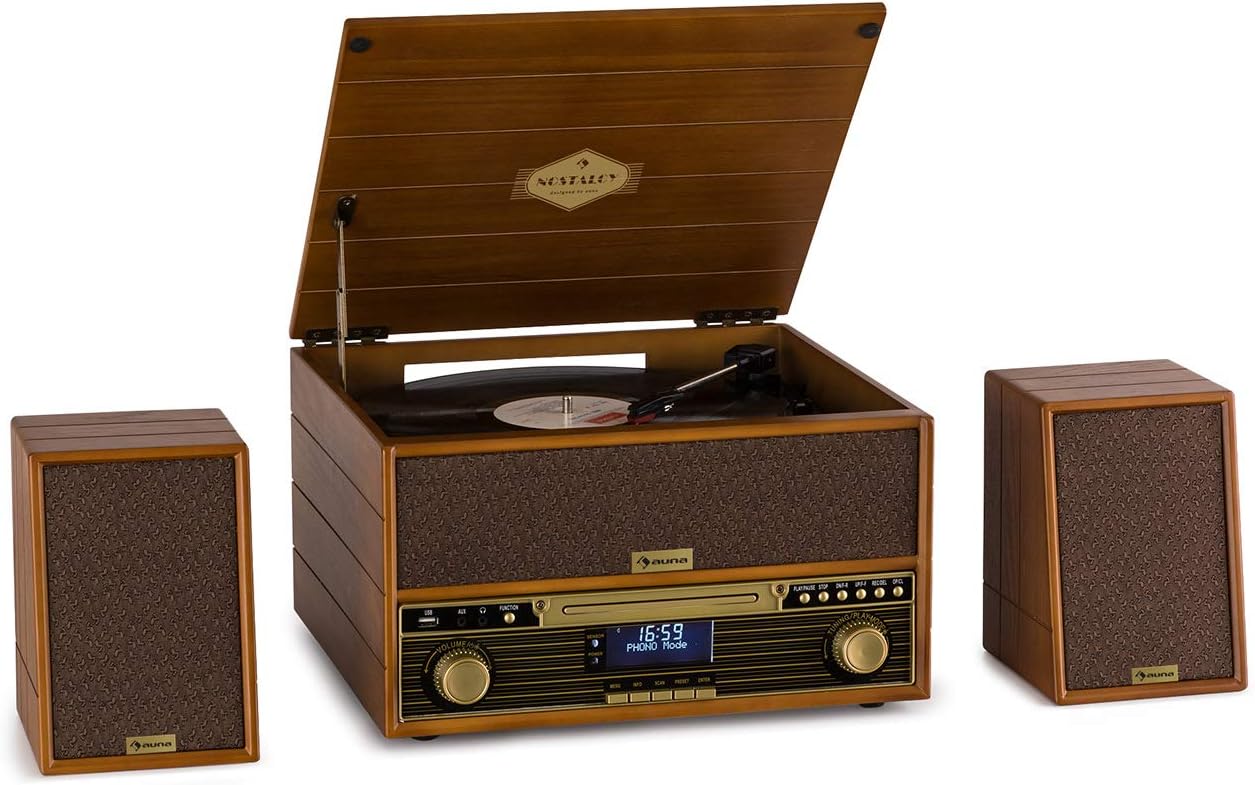
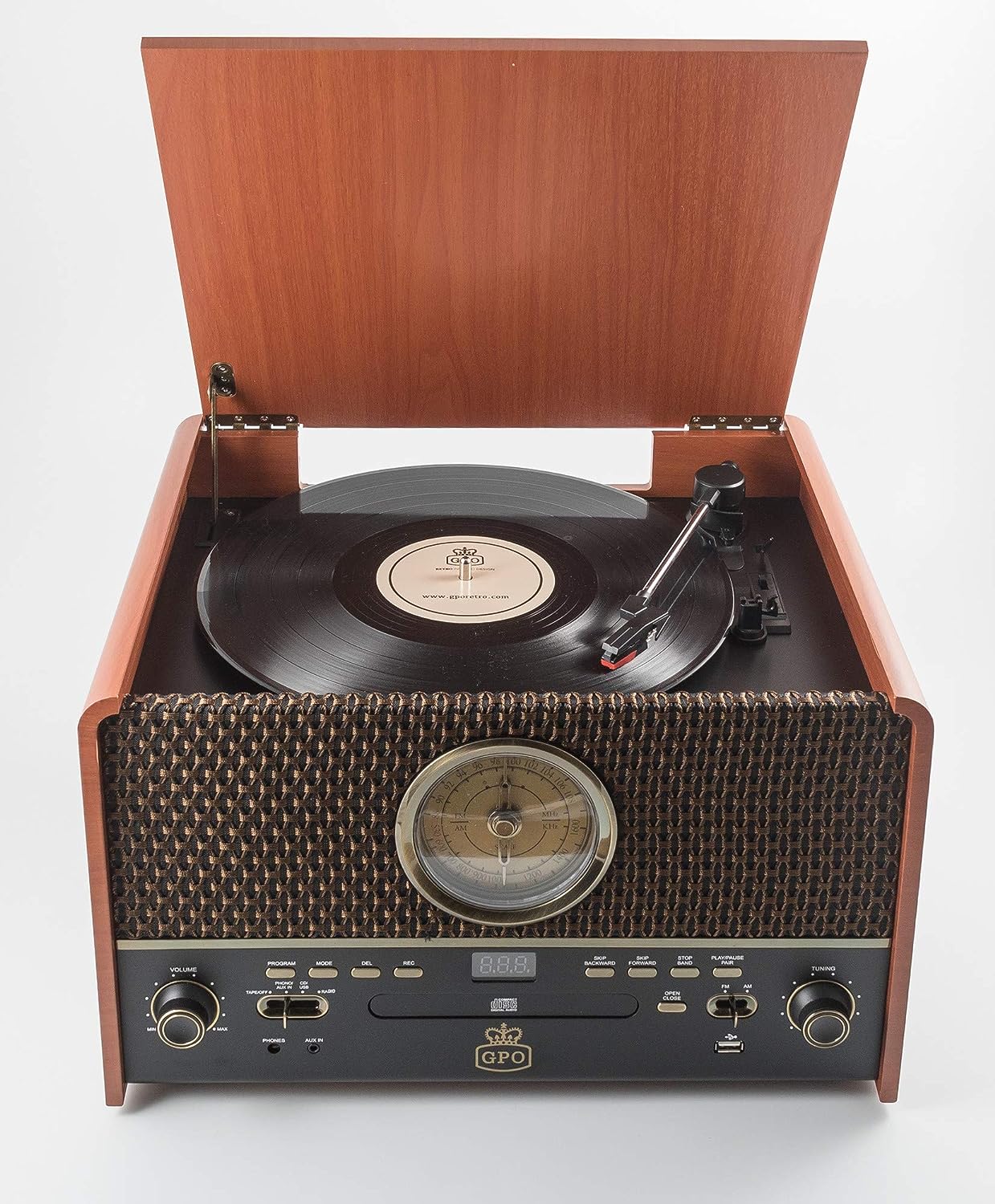
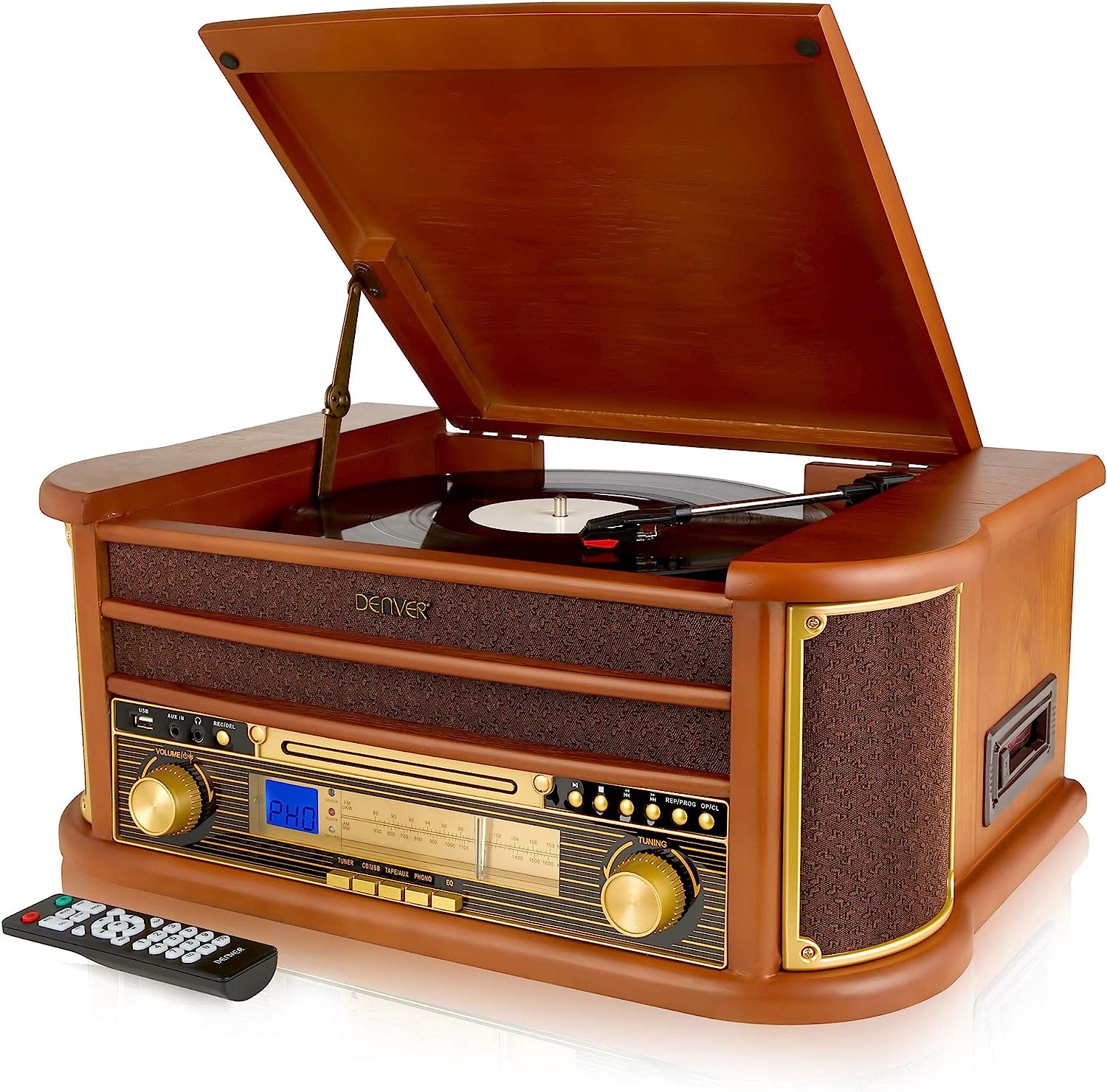
The MCR-50 follows the classic retro music-centre format, with a wooden-look cabinet, front-facing controls, a CD drawer, radio controls, built-in stereo speakers and a top-mounted turntable beneath a hinged dust lid. The overall look is deliberately nostalgic, making it as much a room feature as a playback device.
Construction is convenience-focused, using wooden and plastic materials with integrated speakers, amplifier, tonearm and cartridge. It should not be confused with a component turntable system, as the tonearm and cartridge are not presented as upgrade-focused hi-fi parts.
Practical touches include a blue LCD display, tonearm lock, speed selector, auto-stop control, USB connection, AUX input, headphone output and line output. The cassette mechanism is positioned at the side, which helps keep the front panel tidy but does mean placement should allow access around the unit.
At roughly 51 x 35 x 22 cm for the MCR-50BT retail variant, it is compact for a multi-format system. The quoted weight of around 7.78 kg gives it more presence than a suitcase-style player, though it remains a budget all-in-one design.
Features
The main appeal is format flexibility. The Denver can play vinyl records, CDs, CD-R/CD-RW and MP3 discs, cassettes, AM/FM radio and USB MP3 files, so it suits households with several older media types but limited space for separate equipment.
The turntable supports 33 1/3, 45 and 78 rpm playback, covering LPs, singles and many older records. For valuable 78 rpm discs, stylus suitability should be checked carefully, as no separate 78 stylus specification is clearly confirmed.
On the MCR-50BT retail variant, Bluetooth adds phone or tablet streaming, which makes the unit more useful as a general everyday music player. Bluetooth should not be assumed on every MCR-50 family version, particularly listings labelled only as MCR-50MK3.
USB recording is another useful convenience feature, with supported recording from vinyl, cassette, CD/MP3 disc and AUX input to a USB flash drive. This is best viewed as simple MP3 copying for personal convenience, not as an archival-quality digitisation system.
Setup
Setup should be straightforward for most users. Remove packaging, raise the lid carefully, release the tonearm lock, remove the stylus guard, connect mains power and position the aerial for FM reception.
For records, select phono mode, choose 33 1/3, 45 or 78 rpm, use the 45 rpm adaptor for singles where required, and lower the arm gently using the cueing lever. For cassettes, it is sensible to check for tape slack before insertion.
USB recording requires a flash drive and use of the record function while the chosen source is playing. Bluetooth pairing on the MCR-50BT variant should be simple, but buyers should remember that non-BT MCR-50 family documentation will not cover Bluetooth operation.
Performance
Day-to-day operation is designed to be simple rather than highly adjustable. Select the source, choose the record speed where needed, use the cueing lever for vinyl and let the built-in speakers handle playback without extra equipment.
The turntable is described within the family documentation as belt drive and offers three speeds, but no verified wow, flutter or speed-accuracy figures are available. There is also no confirmed adjustable tracking force or anti-skate, so expectations should be kept in line with a budget integrated player.
Auto-stop helps prevent a record from spinning indefinitely at the end of a side. However, some users report that records can stop early unless the auto-stop control is switched off, so it may need occasional adjustment depending on the disc.
Connectivity is better than many very basic retro players, with AUX input, headphone output, USB and line output. The line output is particularly useful if the internal speakers prove limiting, although it does not turn the built-in turntable mechanism into a higher-grade deck.
Sound quality
The Denver MCR-50 should be judged as a casual music centre, not a dedicated vinyl hi-fi system. Its built-in stereo amplification is quoted at 2 x 2.5 W RMS, which is suitable for modest room listening but naturally limits scale, bass depth and high-volume headroom.
Owner and review-style feedback commonly describes the sound as acceptable or pleasant for everyday use, especially given the convenience of one box. The recurring trade-off is that the presentation can lack depth and refinement compared with separate speakers and a better turntable.
The unspecified cartridge, integrated tonearm and lack of confirmed setup adjustments make it less suitable for valuable or pristine records. For occasional playback of inherited LPs, CDs and tapes it is practical, but vinyl-first listeners should consider a dedicated turntable and powered speakers.
Using the line output with better external equipment may improve loudness and tonal balance compared with the internal speakers. Even so, the underlying record player remains a budget all-in-one mechanism, so expectations should remain realistic.
Pros
- Plays vinyl, CD, cassette, AM/FM radio, USB MP3 files and Bluetooth on the MCR-50BT variant
- Three-speed turntable supports 33 1/3, 45 and 78 rpm records Built-in stereo speakers mean no separate amplifier or speakers are required USB recording is useful for convenient copies of older media Retro wooden-look cabinet suits buyers wanting a nostalgic room feature Line output allows connection to better external audio equipment
Cons
- Built-in 2 x 2.5 W RMS amplification limits bass, volume and scale
- No confirmed adjustable tracking force, anti-skate or cartridge upgrade path
- Bluetooth and DAB claims vary across MCR-50 family listings, so the exact model must be checked USB recording is convenient but not archival-grade
- Some users report early auto-stop behaviour on records
Verdict
The Denver MCR-50 8-in-1 Retro Record Player makes most sense as a convenient, nostalgic music centre for mixed-format collections. Its strengths are breadth, simplicity and self-contained operation rather than audio precision.
As long as expectations are realistic, it can be a practical way to play inherited records, CDs and tapes without building a separate system. The USB recording function and Bluetooth on the MCR-50BT variant add useful modern convenience.
Before buying, confirm the exact model suffix and features, particularly Bluetooth and any radio claims. If vinyl performance, record care and upgrade potential are the priority, put the budget towards a dedicated turntable and separate speakers instead.