Introduction
The Numark TT250 USB Vinyl Turntable is a manual, quartz direct-drive deck with USB recording and DJ-style controls. It suits buyers who want more hands-on control than a basic automatic record player, without moving straight into expensive club-standard equipment.
Watch the product video
Its strongest appeal is to budget-conscious home users, beginner DJs and vinyl owners who want a simple way to connect to line inputs or digitise occasional records. The TT250USB model should not be confused with the older Numark TTUSB, which is a different belt-drive archiving turntable.
As a legacy Numark product, it is most likely to be considered as remaining stock, clearance stock or a used purchase. Condition, completeness and price matter a great deal, especially if the cartridge, stylus, lid or USB accessories are missing.
Design and build
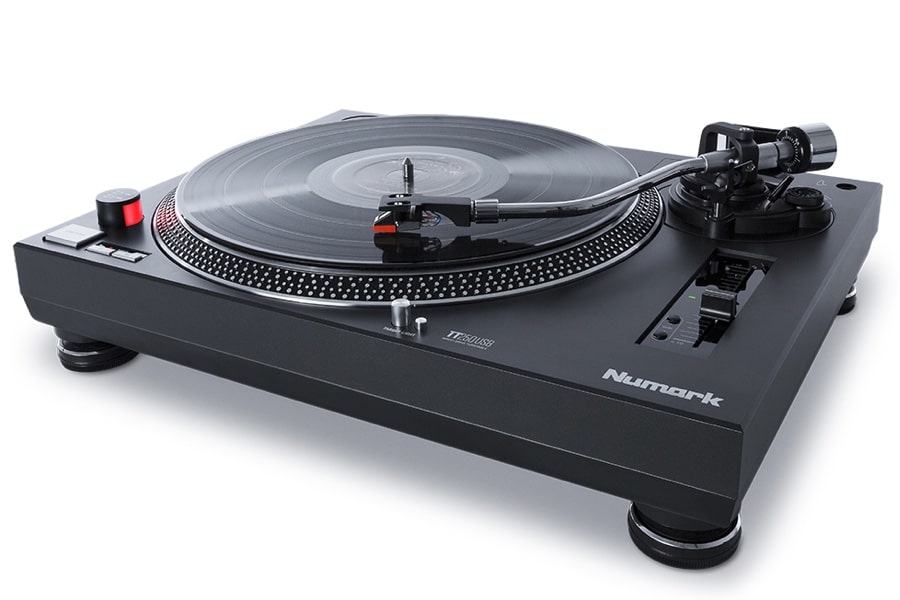
The TT250USB follows the familiar DJ turntable layout, with the platter on the left, S-shaped tonearm on the right, start/stop and speed buttons to hand, and a pitch fader for manual speed adjustment. Strobe markings and a pop-up target light reinforce its DJ-style identity.
Numark specifies a die-cast aluminium platter, adjustable feet, dust cover and an S-shaped tonearm with anti-skate, damped cueing and height adjustment. The inclusion of a detachable headshell gives it a more flexible feel than many fixed-cartridge entry-level decks.
The construction is best understood as affordable professional-style rather than genuinely professional. Specialist feedback has generally regarded it as solid for the money, but not as inert, heavy or refined as serious DJ turntables.
Practical compromises include captive RCA leads and a line-level-only output. These make simple connection easy, but they are less convenient for repairs, cable upgrades or using an external phono stage.
Features
The main feature is the quartz direct-drive motor, which avoids belt fitting and gives quick start-up for cueing, mixing and everyday playback. The deck supports 33⅓ and 45 RPM records, but not 78 RPM.
USB output allows the turntable to connect to a computer for recording records. It was supplied with a USB cable and software download card, although buyers should check current computer and software compatibility, particularly with used examples.
The built-in line-level output means it can connect directly to AUX, CD, tape, mixer line inputs or powered speakers with a suitable line input. There is no documented phono-level bypass or phono/line switch, so it should not be connected to a phono input.
DJ-oriented features include a pitch fader, pitch-bend buttons, target light, strobe and a remote-start input for compatible mixers. The detachable headshell and replaceable cartridge path also make future cartridge changes more realistic than on many very basic USB record players.
Setup
Setup is more involved than a fully automatic beginner record player, but typical for a manual DJ deck. The platter, slipmat, counterweight and dust cover need fitting, and the tonearm must be balanced before tracking force and anti-skate are set.
The official manual states that the supplied headshell and cartridge assembly should be run between 3 g and 5 g. If a different cartridge is fitted, its own tracking-force recommendation should be followed instead.
Connection is simple as long as the output is treated correctly. Use the captive RCA leads with a line-level input only, connect USB to a computer for recording, and check the under-platter voltage selector before use, especially when buying second-hand or imported stock.
Performance
For daily use, the TT250USB is a manual turntable: the user starts the platter, cues the arm and returns it at the end of a side. There is no automatic start, stop or tonearm return, so it rewards careful handling rather than set-and-forget convenience.
The quartz direct-drive system, electronic braking and speed buttons make it more appropriate for cueing and beginner mixing than a simple belt-drive USB deck. Official material lists a start time of less than 0.7 seconds, although published official figures are inconsistent for some motor and wow/flutter details, so exact comparisons should be treated cautiously.
Connectivity is straightforward if the rest of the system has a line input. The attached RCA leads remove the need for a separate phono preamp, while USB adds a convenient route for archiving individual records to a computer.
Its DJ capability has limits. It is suitable for learning cueing, pitch control and basic beat matching at home, but evidence suggests it is less well suited to heavy scratching or harsh booth use than stronger, heavier professional decks.
Sound quality
The supported design points towards a lively, direct presentation for the price, helped by quartz direct drive and a magnetic cartridge supplied on a standard headshell. Published specialist feedback has been broadly positive about clarity and energy, though not without reservations.
The built-in line-level output is convenient, especially for active speakers, mixers and amplifiers without a phono input. Its drawback is upgrade flexibility: because no phono-level bypass is documented, users cannot easily route the cartridge signal through a separate phono stage.
The included cartridge makes the deck usable without an immediate cartridge purchase, provided the stylus is in good condition. The standard headshell arrangement leaves room for cartridge upgrades, which may be worthwhile if the supplied stylus is worn or if smoother tracking and tonal balance are priorities.
This is still a budget DJ-style turntable rather than a purist hi-fi deck. Buyers expecting deep isolation, heavyweight bass authority or a highly refined phono path should compare it carefully with more hi-fi-focused alternatives.
Pros
- Quartz direct-drive system with DJ-style start/stop, pitch fader and pitch-bend controls USB output for recording records to a computer Built-in line-level output works with AUX, line, mixer and powered-speaker inputs S-shaped tonearm with detachable headshell supports cartridge replacement Dust cover, slipmat, counterweight, 45 RPM adapter and USB cable were included in the original package
- Good fit for beginner cueing, mixing practice and everyday manual playback
Cons
- No documented phono-level bypass or phono/line switch Captive RCA cables are less convenient than detachable outputs
- Manual operation only, with no automatic return
- No 78 RPM speed Not ideal for serious scratching or professional booth use USB recording depends on current computer and software compatibility
Verdict
The Numark TT250 USB Vinyl Turntable is a capable budget direct-drive deck for buyers who want DJ-style control, USB recording and simple line-level connection in one unit. Its combination of manual operation, detachable headshell and built-in output makes it more flexible than many basic USB record players.
Its limitations are equally important. Captive cables, line-level-only output, no 78 RPM support and modest suitability for scratching mean it should not be mistaken for a professional club deck or a purist hi-fi platform.
It is most attractive at a sensible used or clearance price, provided the stylus is healthy and the main accessories are present. If the price approaches newer direct-drive USB alternatives, it is worth comparing availability, support and feature differences before buying.